Why ceiling sails are in such demand in trade fair construction
Trade fair booths compete for attention – and the ceiling is often the underestimated design element. A well-planned ceiling sail achieves several things at once: it closes off the booth at the top and creates a sense of enclosure. It conceals technical infrastructure such as cable ducts, power rails and truss structures. And it improves long-distance visibility in the hall, because the booth is perceived as a unified whole.
Without a ceiling sail, even high-quality booths look open and unfinished towards the top. Visitors look up into the hall services instead of into a considered brand world. Particularly with system booths, which generally manage without solid ceiling constructions, textile ceiling solutions are therefore indispensable.
The central issue: sprinkler compatibility
Sprinkler systems are installed in almost all German exhibition halls. The technical guidelines of the major trade fair organisers – from Frankfurt through Munich and Stuttgart to Hanover – clearly regulate what is permitted above the booth and what is not.
The core rule is: booth roofing must not impair the function of the sprinkler system. In the event of fire, smoke and heat must be able to rise unimpeded, and the extinguishing water must fall freely through the ceiling covering – without pooling or being deflected.
Closed ceiling areas above a certain size (generally 30 m²) are only permitted with their own sprinkler system. Textile ceiling sails made of sprinkler-compatible material offer the elegant alternative here – they create the desired visual finish while meeting the requirements at the same time.
The most important regulations at a glance
DIN 4102 B1: The basic requirement for all materials in trade fair construction. The fabric must be flame-retardant. For cotton fabrics this is achieved through a flame-retardant impregnation; for polyester fabrics through permanently flame-retardant fibres (e.g. Trevira CS).
VdS guideline CEA 4001: The guideline of the VdS (Association of Property Insurers) defines the requirements for materials under sprinkler systems. Many trade fairs require VdS-tested sprinkler nets. A general VdS approval for net tulle is often not available – suitability must be assessed case by case by the responsible fire protection authority.
Minimum mesh size: Most hall guidelines require a mesh size of at least 2 × 4 mm or 3 × 3 mm so that the extinguishing water can pass through unimpeded.
Installation position: Sprinkler-compatible ceilings are to be installed between the hall sprinkler and the floor. The fabric sheet must be tensioned horizontally and in a single layer.
Materials for sprinkler-compatible ceiling sails
Cotton net tulle
The standard material for sprinkler-compatible ceiling sails in trade fair construction. An open-mesh net fabric made of 100% cotton at approx. 90 g/m². The net structure allows the free passage of water and smoke, while from a normal viewing height the fabric creates an almost closed impression. Flame-retardant impregnated (B1 to DIN 4102) and available in extra widths up to 500 cm. Typical delivery colours: black and white.
Polyester sprinkler nets (Trevira CS)
For applications with higher demands on durability and permanent flame retardancy. These fabrics do not lose their fire protection even after washing and are particularly suited to repeated use across many trade fair cycles.
Architect's tulle
More finely woven variants for a particularly homogeneous, almost closed impression. Ideal when the visual effect is the priority – for example with high-quality brand booths or special staging.
Fabrication: how fabric becomes a working ceiling sail
Fabrication determines whether a ceiling sail works reliably: whether it can be tensioned cleanly, whether it fits the respective booth construction system and whether it can be reused.
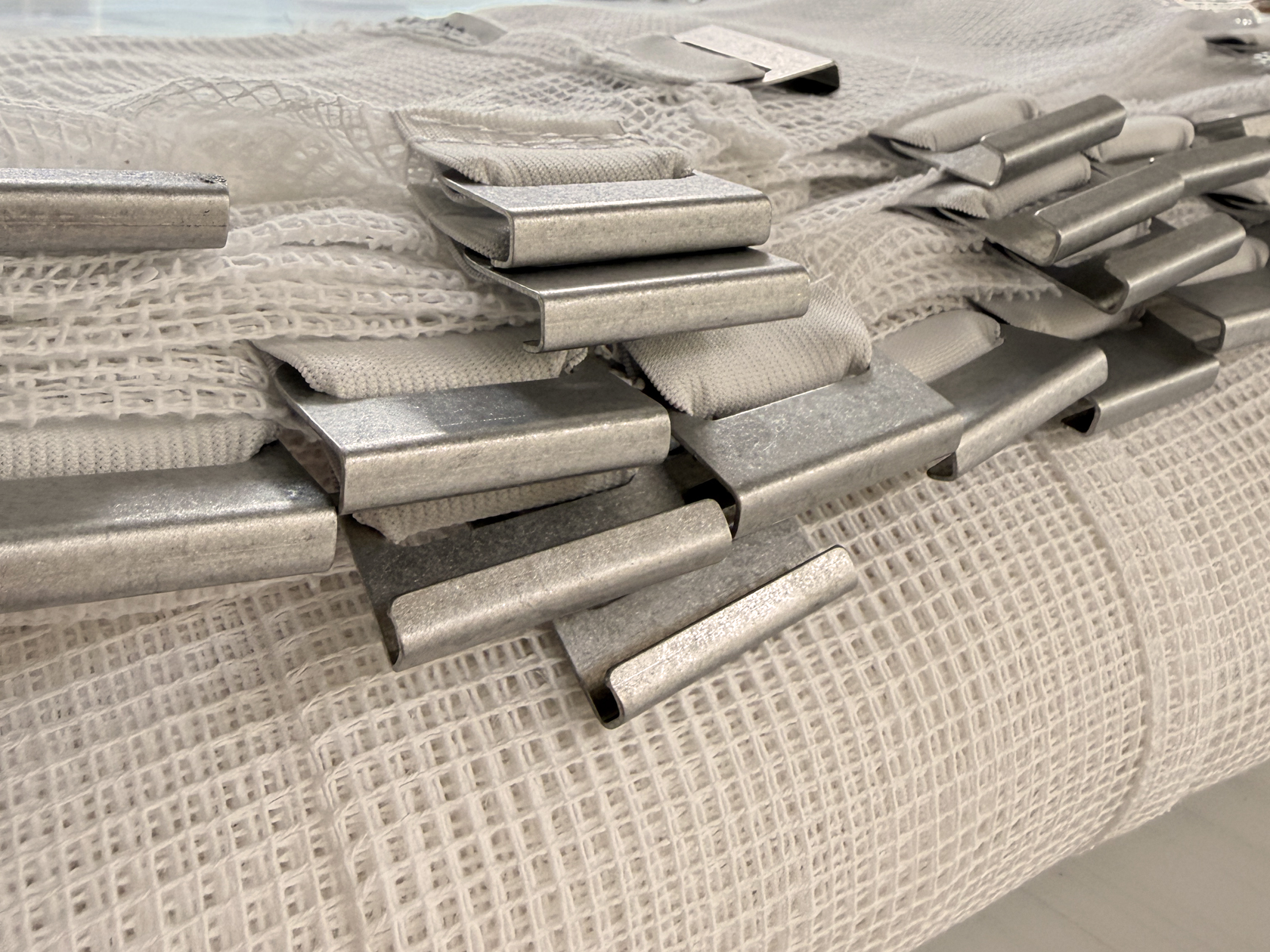
Hook-in hooks with elastic band
The fastest installation solution for system booths. The hooks are fabricated to the sail edge with elastic bands and hooked directly into the frames or profiles. The elastic band compensates for tolerances and ensures even tension. Particularly suited to Syma, Octanorm and other profile systems. Tool-free installation in just a few minutes.
Eyelets with edge reinforcement
The classic and most versatile fastening variant. Metal eyelets in the reinforced edge enable fastening with cable ties, S-hooks or ropes to trusses and suspension points. With textile materials, a binding tape is sewn on that carries the eyelet and protects the fabric from tearing out. Particularly suited to truss systems (Prolyte, Astra) and conventional constructions.
Keder (welt cord)
A plastic welt in the hem of the sail that is fed into a keder rail. Creates a particularly clean, wrinkle-free tension. Common diameters: 7.5 mm, 8.5 mm, 10 mm and 12 mm. Particularly suited to tensioning frame systems and conventional booth builds with an integrated keder rail.
Rod pocket
A folded-over hem for rods, tubes or ropes. Allows even distribution of the tensile forces. Particularly suited to tube and rod systems as well as simple truss suspensions.
Elastic-cord fabrication
Continuous elastic cords along the edge create an even, elastic tension and forgive dimensional tolerances. Particularly suited to flexible booth configurations with changing sizes.
Hook-and-loop tape and reinforced hem
Hook-and-loop tape enables tool-free installation, especially with systems featuring textile covering. A reinforced hem without fixed fastening elements serves as a basis for individual installation on site.
System compatibility
Professional ceiling sails are cut to fit the respective booth construction system exactly. The most common systems:
Syma – A proven Swiss profile system since the 1960s. Ceiling sails are hooked into the standardised frames with hook-in hooks.
Octanorm – German market leader with a worldwide presence. Various fastening options from latch closures through frame mounts to keder rails.
Mero – Specialised in space frames and large-area booth roofing.
Truss systems (Prolyte, Astra, etc.) – Open ceiling constructions of aluminium trusses with fastening by eyelets or cable ties.
Conventional booth construction – Custom booths of wood, metal or mixed construction with keder, eyelet or hook-and-loop fastening.
Colours and visual effect
White creates a bright, open atmosphere and reflects the hall lighting. Ideal for booths that should convey lightness and generosity.
Black makes the ceiling plane visually disappear and draws the gaze to the booth content. Particularly effective with focused lighting and high-quality exhibit presentations.
What matters when ordering
To fabricate a suitable ceiling sail we need: the booth construction system in use, the field dimensions (clear measurements between the profiles), the desired fastening type, the colour and the place of use. On the basis of these details we produce the ceiling sails to exact size and deliver them ready for installation – including all fastening elements and the fire protection documentation.